Commercial Leaf Cleanup in Palatka: A November Scope Guide
A dependable cleanup plan identifies where leaves, pine needles, twigs, and routine litter collect, how crews should handle each surface, and what a completed visit should look like.
Why November Changes the Grounds-Cleanup Plan
As seasonal growth slows, a commercial property may need less frequent mowing while still requiring regular cleanup. Leaves, pine needles, small twigs, and windblown litter can continue to gather around curbs, parking islands, loading areas, walkways, and building edges.
That distinction matters when reviewing a grounds-maintenance contract. If debris removal appears only as the final step after mowing, high-visibility areas may not receive enough attention between cuts.
What Commercial Leaf Cleanup in Palatka Should Cover
Walk the property and document where material collects after wind, rain, normal traffic, or routine landscape work. Give each area a clear outcome instead of relying on a general instruction to “blow the property.”
Entrances and Walkways
Prioritize main entrances, accessible routes, employee paths, covered entries, and building corners.
Parking Areas
Identify parking-space edges, curbs, islands, wheel stops, sign bases, and loading zones.
Turf Areas
Document expectations beneath mature trees and decide when light leaf coverage may be shredded or dense material must be collected.
Landscape Beds
Remove unwanted debris carefully so crews do not displace useful mulch or damage plant material.
Perimeters and Service Zones
Include fence lines, utility areas, gravel, difficult-access locations, and secondary perimeter strips.
Private Drainage Edges
Note contracted areas where debris may restrict normal runoff and define how crews report concerns outside the service boundary.
Define the Work Before Service Begins
A clear commercial debris-removal scope gives the crew, property manager, and approving contact the same standard for each visit.
- List every service zone. Include acreage, pavement, beds, fence lines, entrances, and difficult-access areas.
- Rank priorities. Separate customer-facing areas from secondary perimeter and service zones.
- Define accepted material. Distinguish routine leaves, pine needles, clippings, and litter from oversized or hazardous debris.
- Assign disposal responsibility. State whether collected material leaves the site or goes into an approved container.
- Protect operating hours. Identify delivery periods, pedestrian peaks, gated areas, and noise-sensitive times.
- Set reporting expectations. Require crews to flag blocked access, property damage, large limbs, or drainage concerns.
- Separate public and private areas. Do not treat streets, rights-of-way, or municipal infrastructure as contracted space unless approved.
- Document exclusions. Tree removal, hazardous waste, and emergency storm response require separate evaluation.
Match the Cleanup Method to the Material
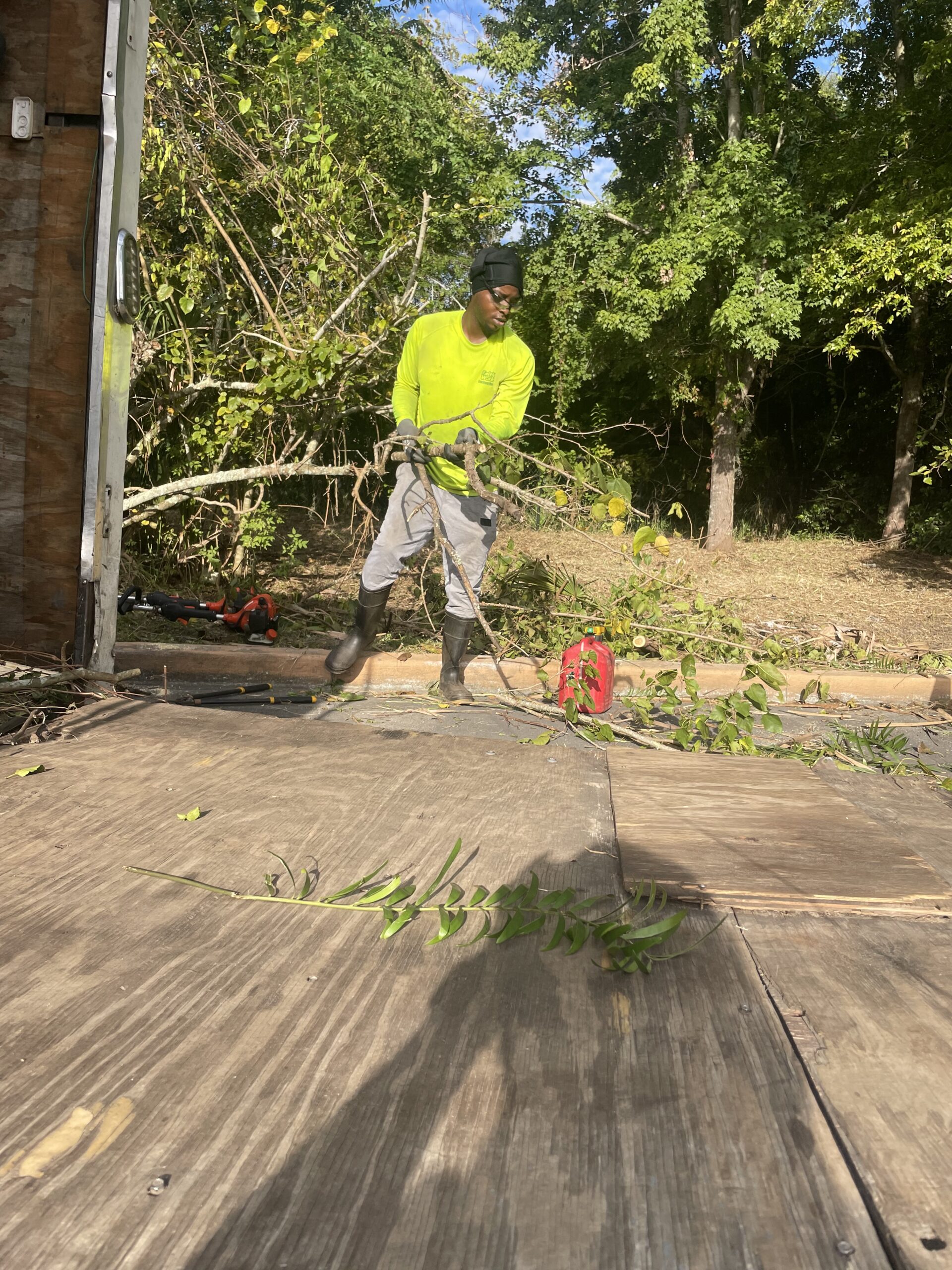
One method does not fit every part of a commercial property. Paved entrances may require complete removal. Turf may allow light leaves to be shredded when conditions and appearance standards permit, while dense accumulation may require collection.
Landscape beds require careful handling so useful mulch is not displaced with unwanted debris. Meanwhile, large limbs, storm damage, hazardous waste, and emergency response should not be assumed to fall within routine service.
Make the boundary explicit
Define what crews may collect during a standard visit, what they must report, and what requires approval before additional work begins.
Use Dates and Condition-Based Service Triggers
A weekly or biweekly schedule provides a starting point. However, some Palatka properties may also need condition-based service after strong winds, a large leaf drop, or an event that creates additional litter.
1. Set the Baseline
Choose an initial frequency based on tree coverage, property standards, pedestrian activity, and the amount of material accumulating between visits.
2. Define the Trigger
Describe the conditions that justify an extra visit and identify who may request or approve the work.
3. Standardize Reporting
For multi-site portfolios, use the same photo, approval, and completion process at every location.
Inspect the Property After Service
Follow the same route a visitor or tenant would take. Start at the primary entrance, continue along pedestrian routes, inspect parking edges and islands, and finish with perimeter and service areas.
Confirm that leaves were not simply moved from a visible area into a bed, neighboring parcel, street, or drainage path. Photos can document recurring accumulation points and improve the next service plan.
Look for material left against:
- Curbs and wheel stops
- Signs and utility fixtures
- Doors and covered entries
- Parked vehicles
- Fences and property lines
- Private drainage paths
Plan Cleanup Around Commercial Grounds Maintenance
Leaf and debris cleanup should coordinate with mowing, edging, trimming, bed care, and litter control. A combined plan reduces duplicated work and clarifies what crews should complete during reduced-growth visits.
Faithworks provides commercial grounds maintenance through its Palatka regional branch, including blowing and routine debris removal within an approved property scope.
Review related services
Questions From Palatka Property Managers
Is leaf cleanup automatically included with commercial mowing?
Not necessarily. Typical grounds scopes may include blowing and routine debris removal, but the approved agreement should identify the exact areas, frequency, disposal method, and limits.
How often should a Palatka commercial property schedule leaf cleanup?
Frequency depends on tree coverage, appearance standards, pedestrian activity, wind exposure, and the amount of material accumulating between visits. A site walk can establish an initial schedule and extra-service triggers.
Does routine cleanup include large limbs or storm debris?
Property managers should not assume that it does. Identify oversized material, storm damage, hazardous waste, and emergency response as separate conditions that require review before work is authorized.